




Most employers think they have a talent shortage.
The truth is they usually have a skills-definition problem.
Hiring platforms don't create qualified candidates. They amplify the quality of the hiring process you already have. If your job description is vague, your applicants will be too.
After more than a decade researching hiring platforms and helping employers improve their hiring process, I've noticed the same pattern over and over again. The biggest hiring improvements almost always happen before the job is ever posted.
Business owners often assume they need a different job board, a bigger recruiting budget, or more applicants. In reality, they usually need more clarity.
When you define success before you start recruiting, everything else gets easier. You write a better job description. You choose the right hiring channels. You ask better interview questions. And you make hiring decisions based on evidence instead of instinct.
That's exactly what this guide will help you do.
Instead of focusing on collecting more resumes, you'll build a repeatable system for finding people who can actually succeed in the role.
How do you find employees with the right skills?
Start by identifying the few skills a new hire must have on day one, write a job description around those skills, choose the sourcing channel that matches your hiring challenge, and verify those skills through structured interviews or work samples before making an offer.
Quick verdict
- Best for: Small businesses hiring one to three employees
- Works best when: You define skills before posting the job
- Skip if: You are hiring executive leadership through retained search
- Alternative: Executive recruiters or specialized recruiting firms
Step 1: Define the Skills You Actually Need
The fastest way to improve hiring quality is to define the few skills that are truly required before you post the job.
Most hiring failures begin with vague job descriptions—not a lack of applicants.
I've made this mistake myself. Early on, I thought adding more requirements would attract stronger candidates. Instead, I created long wish lists that discouraged qualified people from applying while making interviews harder because I wasn't even sure which qualifications actually mattered.
That experience changed how I think about hiring.
The goal isn't to list everything a candidate could do. The goal is to identify what they must be able to do during their first 90 days.
That's a much shorter list.
I recommend separating every role into three categories:
- Must-have skills
- Trainable skills
- Evidence you'll require before making an offer
This simple exercise forces you to prioritize.
Instead of asking, "What would be nice to have?" ask yourself, "If someone couldn't do this on day one, would they fail in the role?"
If the answer is yes, it belongs in the must-have column.
If the answer is no, it's probably something you can teach.
CareerCloud Must-Have Skills Framework
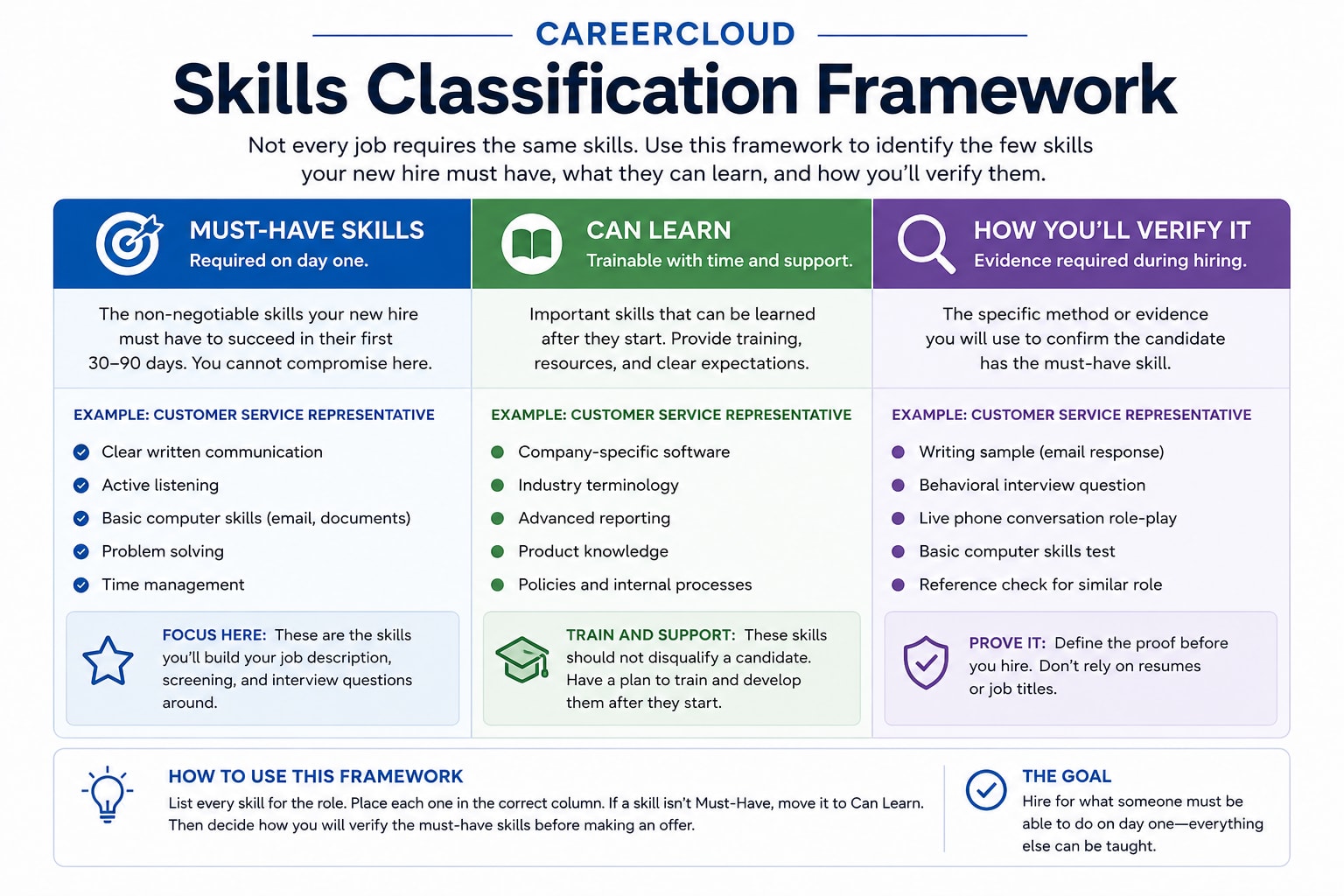
The framework is intentionally simple because hiring decisions become more consistent when evaluation criteria stay simple.
For example, if you're hiring a customer service representative, your framework might look like this:
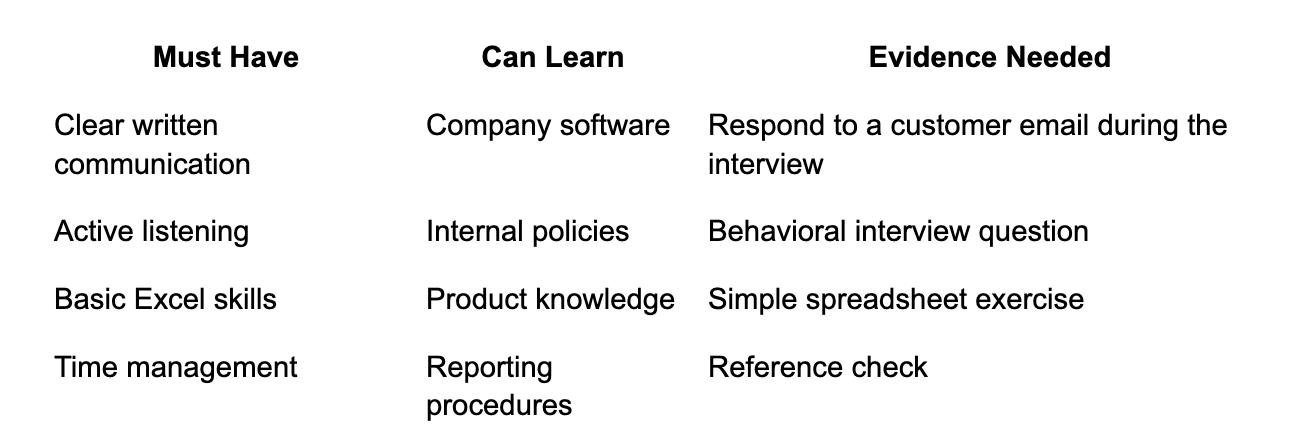
Notice what isn't included.
There's no requirement for a specific degree.
There's no arbitrary "five years of experience."
There's no preference for someone who's worked in the exact same industry.
Instead, you're identifying the capabilities someone needs to succeed.
This approach aligns with the growing shift toward skills-based hiring. SHRM notes that many employers are reducing degree requirements and focusing instead on job-relevant skills because rigid educational requirements can unnecessarily filter out otherwise qualified candidates.
Transferable skills matter more than many employers realize.
Someone who has managed schedules in a busy medical office may transition successfully into an operations coordinator role. A restaurant manager often has stronger customer service, conflict resolution, and leadership skills than someone with years in a slower-paced office environment.
Focus on what someone can do—not just where they've worked.
If you're unsure which competencies belong in a role, the U.S. Department of Labor's O*NET Online database is one of the best free resources available. It breaks occupations into specific skills, knowledge areas, work activities, and abilities that employers can adapt to their own hiring process.
Hiring software helps you find candidates. Hiring systems help you hire better employees.
Hard Skills vs. Soft Skills
Hard skills determine whether someone can perform the work, while soft skills determine how consistently they'll perform it.
Hard skills are measurable abilities.
Examples include: Excel reporting, bookkeeping, coding, payroll processing, graphic design, or operating specialized equipment.
Soft skills are often misunderstood because they're treated like personality traits.
They're not.
Communication can be observed.
Reliability can be measured.
Adaptability shows up in how someone responds to change.
Problem-solving becomes obvious when you ask candidates to explain how they've handled difficult situations.
The National Association of Colleges and Employers (NACE) consistently ranks communication, teamwork, critical thinking, and professionalism among the competencies employers value most because they predict workplace success across industries.
One phrase I recommend removing from your hiring process is "culture fit."
It's vague.
More importantly, it's difficult to evaluate consistently.
Instead, define measurable workplace behaviors.
For example, instead of saying you want someone who is "a good culture fit," describe the behaviors that matter:
- Responds professionally to feedback
- Communicates proactively
- Meets deadlines consistently
- Collaborates respectfully across teams
Those are observable.
Those are coachable.
And those are much easier to evaluate fairly.
Define Outcomes Instead of Tasks
The best job descriptions describe results instead of responsibilities.
This is one of the biggest improvements you can make before posting a position.
Here's what I mean.
❌ Manage customer service emails.
That describes a task.
It tells applicants what they'll do but not what success looks like.
Now compare it to this:
✅ Respond to customer inquiries within one business day while maintaining a 95% customer satisfaction rating.
Now you've defined the outcome.
Applicants immediately understand the expectation.
Interview questions become easier because you can ask candidates how they've achieved similar results before.
Performance reviews become easier because expectations were clear from the beginning.
I've used the same reminder for years:
Tasks attract doers. Outcomes attract thinkers.
When you write your next job description, focus less on daily activities and more on the results the person will produce during their first 90 days.
If you need help structuring your posting, see our guide on How to Write a Job Description, and use O*NET as a reference to validate occupation-specific competencies before publishing.
Step 2: Choose the Right Place to Find Skilled Employees
The best place to find skilled employees depends on the type of skills you're hiring for—not the size of your hiring budget.
One of the biggest hiring mistakes I see is choosing a recruiting channel before defining the role.
That's backwards.
If you don't know exactly what skills you're hiring for, every recruiting platform looks the same. You'll end up posting everywhere, collecting hundreds of resumes, and spending hours reviewing applicants who were never a good fit.
Your sourcing strategy should always follow your skills strategy.
The channel that works well for a customer service representative probably isn't the best place to recruit a software developer. Likewise, the approach you'd use to hire a licensed electrician is completely different from how you'd hire an office administrator.
There isn't a single hiring platform that's best for every situation.
There is, however, a best platform for your hiring challenge.
Most founders don't have a sourcing problem. They have a matching problem.
Once you've clearly defined the skills you need, you can choose the recruiting channel that's most likely to reach candidates with those qualifications.
Job Boards
Job boards are the best option when you need broad visibility across a large talent pool.
For most small businesses hiring one to three employees, this is where I recommend starting.
Why?
Because applicant volume still matters.
You can't hire qualified people who never see your job posting.
Here are four job posting platforms worth considering:
- ZipRecruiter – Best for small businesses that want broad job distribution and candidate matching.
- Workable – Best for employers who need recruiting software to manage job postings, applicants, and interviews in one place.
- SimplyHired – An option for employers looking to reach candidates through a general job search platform.
- Glassdoor – Useful for reaching candidates who research company reviews, salaries, and workplace culture before applying.
If you're hiring one to three positions and need qualified applicants quickly, ZipRecruiter is the platform I recommend most often. According to ZipRecruiter, employers can distribute a single job posting to more than 100 job boards with one click. Its matching technology also identifies candidates based on their skills, education, and experience, then invites them to apply.
For small businesses without dedicated recruiting teams, that means less time posting jobs manually and more time evaluating potential hires.
Just remember that software helps you find candidates. It doesn't make the hiring decision for you.
That's an important distinction.
No hiring platform alone can verify whether someone can actually perform the work.
It doesn't replace interviews.
It doesn't evaluate judgment.
It doesn't confirm communication skills.
It doesn't guarantee a great hire.
That's your job.
Think of recruiting software as the top of your hiring funnel—not the entire hiring process.
Employee Referrals
Employee referrals consistently produce some of the highest-quality hires because trust already exists.
When your current employees recommend someone, they're putting their own reputation on the line.
That typically leads to stronger candidates.
Referral hires also tend to stay longer and cost less to recruit because you aren't relying exclusively on paid advertising or external recruiters.
The downside is scale.
If your current team is small, your referral network is small too.
Referrals should strengthen your hiring strategy—not become your only recruiting source.
LinkedIn Recruiting
LinkedIn works best when you need to proactively recruit experienced professionals.
Unlike traditional job boards, LinkedIn gives employers access to passive candidates who may not be actively applying but are open to the right opportunity.
That's especially valuable for:
- Managers
- Technical specialists
- Experienced sales professionals
- Finance leaders
- Executive positions
The tradeoff is time.
Proactive recruiting typically requires more outreach, more conversations, and longer hiring timelines than posting a job and reviewing inbound applicants.
For specialized hiring, though, it's often worth the extra effort.
Niche Recruiting Sources
Specialized hiring channels outperform general job boards when credentials or licensing matter.
If you're hiring licensed electricians, nurses, HVAC technicians, or heavy equipment operators, broad job boards should be only one part of your recruiting strategy.
You'll often find better candidates through:
- Trade schools
- Apprenticeship programs
- Workforce development organizations
- Professional associations
- Local industry groups
For skilled trades, I also recommend reviewing resources from the U.S. Department of Labor's Apprenticeship program. Registered apprenticeship programs remain one of the strongest long-term pipelines for skilled workers because employers help develop talent while meeting industry training standards.
The lesson here is simple.
Don't ask every recruiting channel to solve every hiring problem.
Choose the one that matches the skills you're actually trying to find.
More importantly, remember what we've covered so far.
Defining skills comes first.
Finding candidates comes second.
The employers who reverse that order usually spend far more time hiring—and often end up making weaker hiring decisions because they started with the platform instead of the process.
Step 3: Screen Candidates for Skills Before You Schedule Interviews
The best way to identify qualified candidates is to screen for skills before investing time in interviews.
By the time you're scheduling interviews, you should already have confidence that every candidate meets your minimum requirements.
That's not what happens in most hiring processes.
Instead, employers post a job, collect resumes, and start interviewing based on job titles, years of experience, or gut instinct.
That's an expensive use of your time.
A resume tells you what someone claims they can do.
It doesn't tell you what they can actually do.
Structured screening helps solve that problem.
According to SHRM, structured interviews improve hiring consistency by evaluating every candidate against the same job-related competencies instead of relying on subjective impressions. That makes it easier to compare applicants based on demonstrated skills rather than where they worked previously.
Every must-have skill you identified in Step 1 should have a corresponding screening question.
If communication is essential, ask about communication.
If Excel proficiency matters, ask for an example of a spreadsheet they've built.
If customer service experience is critical, ask them to describe a difficult customer interaction they've handled successfully.
Keep it simple.
For most small businesses, three to five screening questions are enough to separate qualified applicants from everyone else.
Candidate matching technology can also help prioritize applications, but I still recommend reviewing candidates yourself before moving them to the interview stage.
Algorithms can identify patterns.
Only you can determine whether someone fits the role you've defined.
Write Better Screening Questions
The best screening questions require candidates to describe what they've already done rather than what they think they could do.
Too many employers ask questions that invite generic answers.
For example:
❌ "Are you good with Excel?"
Almost everyone will answer yes.
The response tells you nothing.
Instead, ask something like this:
✅ "Tell me about the most complex spreadsheet you've built and what problem it solved."
Now you're asking for evidence.
Strong screening questions also:
- Ask for specific examples.
- Focus on measurable results.
- Encourage candidates to explain their thought process.
You'll quickly notice a difference.
Candidates with genuine experience usually answer with details, numbers, and outcomes.
Candidates who exaggerate their abilities often stay vague.
That's exactly what your screening process is supposed to reveal.
Know When to Use Skills Assessments
Skills assessments are most valuable when success depends on technical ability rather than interview performance.
Not every position requires testing.
But some absolutely do.
If you're hiring for a role where the work itself is measurable, consider asking candidates to demonstrate the skill before moving forward.
Examples include:
- Software development: Coding assessment
- Customer service: Respond to a sample customer email
- Bookkeeping: Complete a spreadsheet exercise
- Marketing: Write a short social media post or product description
- Graphic design: Review a design portfolio or complete a small design exercise
Notice that each assessment mirrors the actual work.
That's the point.
The closer your assessment resembles the job itself, the more useful it becomes.
If you want a dedicated assessment platform, TestGorilla is one well-known option that offers role-specific skills tests across technical and professional disciplines. Just don't let the assessment become the hiring process.
Keep exercises short.
I recommend limiting them to 30 to 60 minutes whenever possible.
And if you're asking candidates to complete work that creates meaningful value for your business, pay them for their time.
There's a big difference between evaluating a candidate and asking someone to provide free labor.
Respect that line.
The strongest hiring processes combine structured screening with practical demonstrations of skill—not one or the other.
Step 4: Verify Skills During the Interview Process
Interviews should verify the skills you identified earlier—not introduce entirely new evaluation criteria.
By the time a candidate reaches the interview stage, you shouldn't be deciding what matters.
You already did that in Step 1.
Now you're simply confirming whether the candidate can consistently demonstrate those skills.
This is where many interviews go off track.
Someone asks an interesting question.
Another interviewer adds a few of their own.
The conversation turns into an informal chat.
Everyone leaves with a different impression.
Then the hiring team compares opinions instead of evidence.
I've seen this happen more times than I can count.
Consistency is what makes interviews useful.
Every candidate should be evaluated against the same core competencies.
The follow-up questions can change based on someone's experience.
The evaluation framework shouldn't.
Behavioral interviewing works because past behavior is often one of the strongest predictors of future performance. SHRM continues to recommend structured interviews because they improve consistency and reduce bias compared with unstructured conversations.
One reminder I come back to often is this:
A resume is what someone says they can do. A work sample is what they can actually do.
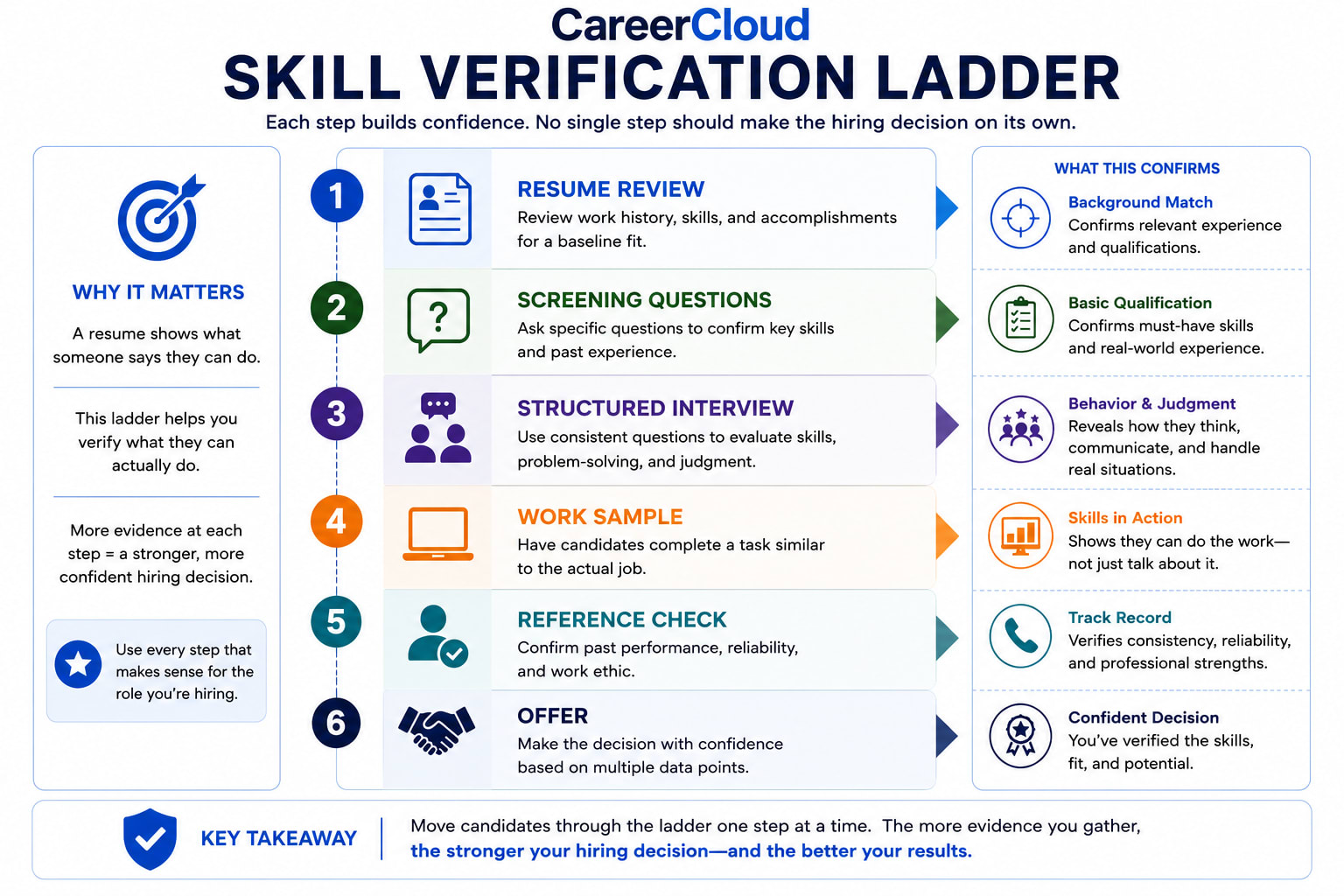
Behavioral Interview Questions
Behavioral interview questions help you understand how candidates handled real situations in the past.
Instead of asking hypothetical questions like, "What would you do if...", ask candidates to explain what they've already done.
For example:
- Tell me about a time you solved a difficult customer problem.
- Describe a project that didn't go according to plan. What happened?
- What's the most challenging deadline you've ever managed?
- Tell me about a time you had to learn a new system quickly.
The first answer is only the beginning.
The follow-up questions usually provide the most valuable insights.
Ask questions like:
- What was your specific role?
- What did you learn?
- What would you do differently today?
- How did you measure success?
Candidates who truly own their work can usually explain both the outcome and the process that led to it.
For more examples, read our guide on behavioral interview questions to ask candidates.
Work Samples Beat Guesswork
A short work sample is often the most accurate predictor of future job performance.
Whenever practical, let candidates demonstrate the work they'll actually perform.
Here are a few examples:

In fact, they're usually better when they're simple.
Aim for something that takes no longer than 30 to 60 minutes and closely reflects the responsibilities of the role.
One more recommendation.
Never ask candidates to complete unpaid work that directly benefits your business.
If the assignment creates real business value, compensate them fairly for their time.
That's good hiring—and good business.
Don't Skip Reference Checks
Reference checks should confirm the behaviors you observed during the hiring process rather than uncover surprises.
If you're relying on references to tell you whether someone is qualified, something earlier in your hiring process probably broke down.
Instead, use references to validate what you've already seen.
Ask questions like:
- Was this person dependable?
- How did they communicate with teammates and customers?
- How did they respond to feedback?
- Would you hire them again?
Those questions are much more valuable than asking whether someone was "good."
Reference checks should reinforce your decision—not make it for you.
By the time you're making the reference calls, the right candidate should already be obvious based on the evidence you've collected throughout the hiring process.
Step 5: Don't Mistake a Compensation Problem for a Skills Problem
Many hiring challenges that look like skills shortages are actually compensation or expectation mismatches.
When employers tell me, "We can't find qualified candidates," one of my first questions is always the same:
What are you paying?
The answer often explains more than the job description does.
A company looking for someone with ten years of experience, specialized certifications, management experience, and advanced technical skills shouldn't expect a large applicant pool if the salary is aligned with an entry-level position.
That's not a recruiting problem.
It's a market problem.
If qualified candidates aren't applying, compensation should be one of the first things you evaluate—not the last.
Salary isn't the only factor, either.
Before assuming there's a talent shortage, compare your compensation against local market data. The U.S. Bureau of Labor Statistics publishes wage and compensation data by occupation, industry, and geographic area, making it one of the best benchmarks for evaluating whether your pay is competitive.
According to 2026 data from ZipRecruiter, 60% of recent hires reported higher pay as their top reason for switching jobs.
I've also seen employers create what I call the "unicorn job description."
They combine responsibilities from three different positions, expect expertise in every software platform the company uses, require a bachelor's degree, and then wonder why nobody applies.
The market isn't rejecting your company.
It's rejecting unrealistic expectations.
Most employers don't have a recruiting problem. They have a value proposition problem.
Related: How To Find Employees In A Competitive Job Market
Benchmark Before You Rewrite the Job Posting
You should compare your compensation against the market before assuming there aren't qualified candidates.
Start with salary.
Then compare the rest of your offer.
Ask yourself:
- Is your salary competitive for your location?
- Are your benefits comparable?
- Do you offer scheduling flexibility?
- Are your experience requirements higher than similar positions?
I've seen companies dramatically increase qualified applicants simply by removing unnecessary degree requirements or reducing unrealistic experience expectations.
Sometimes the talent is already there.
You've just made the barrier to entry too high.
Know When Upskilling Makes More Sense Than Hiring
Sometimes the fastest way to gain a needed skill is to develop someone you already employ.
This works especially well when the missing skill is teachable.
For example, it's often easier to teach an organized administrative assistant a new project management platform than it is to recruit an entirely new employee who already knows the software.
Internal development also improves retention.
Employees who receive training are more likely to see long-term career opportunities within your organization.
That doesn't mean you should always promote from within.
If you're missing strategic leadership, specialized certifications, or experience your current team simply doesn't have, external hiring is usually the better choice.
The key is understanding the difference between a teachable gap and an expertise gap.
One can be developed.
The other usually needs to be hired.
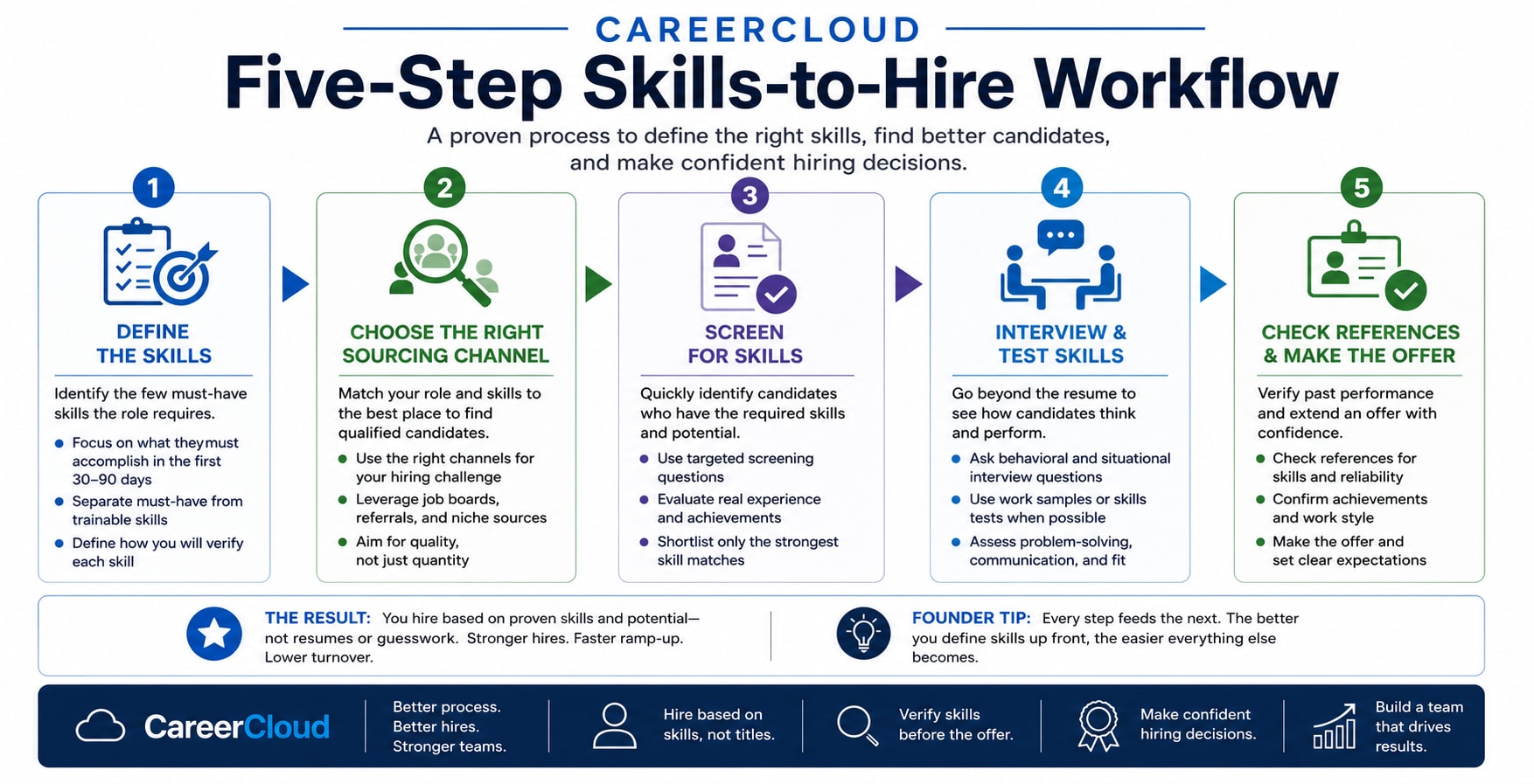
The CareerCloud Five-Step Skills-to-Hire Framework
Finding employees with the right skills becomes much easier when you follow the same hiring process every time.
Most hiring problems don't happen during the interview.
They happen much earlier.
Skip the skills definition step, and you'll write a vague job description.
Write a vague job description, and you'll attract vague applicants.
Interview vague applicants, and you'll make inconsistent hiring decisions.
Every step builds on the one before it.
Here's the framework I recommend for nearly every small business:
- Define the skills your new hire needs on day one.
- Write an outcome-based job description focused on results instead of responsibilities.
- Choose the recruiting channel that matches the role.
- Screen and verify skills through structured questions, interviews, and work samples.
- Make an evidence-based hiring decision supported by references and objective evaluation.
Hiring software helps you find candidates. Hiring systems help you hire better employees.
CareerCloud Five-Step Skills-to-Hire Workflow
Frequently Asked Questions
How do you find employees with the right skills?
Start by identifying the few skills a new employee must have on day one, write a job description around those skills, advertise through the hiring channel that best fits the role, and verify those skills through structured interviews or work samples before making an offer.
What is the best way to hire skilled employees?
For most small businesses, the best approach combines a skills-based job description, broad job distribution through job boards, structured screening questions, and a short work sample. Together, these steps produce better hiring decisions than relying on resumes alone.
Where should I look for skilled employees?
The best recruiting source depends on the position. Job boards can help businesses find qualified candidates across a wide range of roles, from general professional positions to specialized technical roles and skilled trades. Depending on your hiring needs, niche recruiting channels or proactive sourcing can also help expand your reach.
How do you verify candidate skills before hiring?
Verify skills using the simplest method that directly measures the work. Certifications confirm licenses, screening questions verify experience, interviews evaluate judgment, work samples demonstrate ability, and reference checks confirm reliability.
Is ZipRecruiter enough to hire qualified employees?
Yes! ZipRecruiter is excellent for distributing jobs and matching candidates, but employers should still verify skills through structured interviews, work samples, and reference checks before making a hiring decision.
Bottom Line
Finding employees with the right skills isn't about collecting more resumes.
It's about creating a hiring process that consistently identifies the people who can solve the problems your business actually has.
The clearer you become about what success looks like, the easier it becomes to recognize the right candidate when they apply.
Because great hiring isn't about finding perfect candidates.
It's about building a process that consistently helps you recognize the right ones.

