




Most founders think hiring is a recruiting problem. The truth is it's a leverage problem.
You do not need more applicants. You need a faster way to identify the right applicants without becoming a full-time recruiter.
Hiring isn't about filling a role. It's about buying back your time.
That's a lesson I've learned after years of studying hiring platforms and talking with founders who wear every hat in their business. Most aren't struggling because great candidates don't exist. They're struggling because they don't have enough hours in the day to find, screen, interview, and hire them.
The irony is that waiting to hire usually makes the problem worse.
Every week you delay bringing someone onto your team is another week you're answering customer emails, handling administrative work, or putting off projects that could actually grow your business. Hiring your first employee isn't just about getting more work done—it's about creating the capacity to focus on the highest-value activities that move your business forward.
Research from the U.S. Small Business Administration identifies hiring the first employee as one of the most important milestones in a company's growth.
I've seen founders spend weeks trying to write the perfect job description, compare every hiring platform, and save a few hundred dollars on recruiting costs. Meanwhile, they're losing thousands of dollars in missed opportunities because everything still depends on them.
The businesses that hire well don't necessarily have the biggest recruiting budgets.
They have the clearest hiring process.
If you're trying to hire employees with limited time and resources, the goal isn't to attract the most applicants.
It's to spend less time hiring while making a better hiring decision.
How can a small business hire employees with limited time and resources?
The fastest approach is to use a hiring channel that reduces sourcing and screening work, create a clear job description, and focus only on qualified applicants instead of maximizing application volume.
Quick verdict
Best for: Small-business owners hiring while running day-to-day operations
Cost: Free to several hundred dollars depending on the hiring channel
Skip if: You have a dedicated recruiter or HR department
The Real Problem Isn't Hiring. It's Founder Bandwidth.
Most small-business hiring problems are actually time-management problems, not recruiting problems.
When founders tell me they're too busy to hire, I usually tell them the opposite is true.
They're too busy not to hire.
I understand why it happens. Hiring feels like one more project on an already impossible to-do list. Writing a job description, posting it online, reviewing resumes, scheduling interviews, checking references—it all sounds overwhelming when you're already working 10-hour days.
So you wait.
Next month feels like a better time.
Then next quarter.
Then after the busy season.
I've watched that cycle play out countless times, and it almost always ends the same way.
The owner becomes the bottleneck.
Customer response times slow down.
Growth stalls.
The team starts feeling stretched.
The founder works nights and weekends trying to keep everything moving.
The problem was never a lack of candidates.
It was a lack of leverage.
Your next hire is not an expense. It's a leverage investment.
That's one of the biggest mindset shifts I wish more founders would make.
The right employee doesn't just complete work. They create time for you to focus on the decisions that only you can make. That's where founders create the most value.
The U.S. Small Business Administration identifies hiring and managing employees as a core part of running and growing a small business. Bringing on the right person can help you distribute daily responsibilities and create more capacity for the work that moves the business forward.
Buying back your time isn't a luxury.
It's one of the highest-return investments most founders will ever make.
What Delayed Hiring Actually Costs
Waiting too long to hire often costs more than hiring imperfectly.
Most founders calculate the cost of adding an employee.
Very few calculate the cost of waiting.
Every week an important role stays vacant creates an opportunity cost somewhere else in the business. Maybe sales opportunities aren't getting followed up on. Maybe customers are waiting longer for support. Maybe marketing projects keep getting pushed to next month because there simply aren't enough hours.
Those costs rarely show up on a financial statement.
They're still real.
The longer you delay hiring, the more likely you are to become the person every decision flows through. That might work when your business is new.
It doesn't work when you're trying to grow.
I've talked with founders who proudly told me they were "saving money" by handling everything themselves.
Six months later, they were exhausted, behind on customer work, and wondering why growth had stalled.
The payroll expense they were trying to avoid was far smaller than the revenue they never had time to create.
Founder attention is one of the most valuable resources in any small business.
Once it's consumed by work someone else could do, growth almost always slows down.
You might also get value from our guide on How To Hire Employees Fast.
The Best Hiring Channels for Employers With Limited Resources
The best hiring channel depends on whether your biggest constraint is time, budget, candidate quality, or urgency.
One of the most common questions I hear is, "What's the best place to post a job?"
The honest answer is that there isn't one.
The best hiring platform for a restaurant isn't necessarily the best platform for a software company. The best option for a founder making their first hire isn't always the best option for a business that's hiring ten people this quarter.
Too many employers choose a hiring platform based on price alone.
I think that's a mistake.
If you're already stretched thin, saving $200 on a job posting isn't much of a win if it costs you another 15 hours sorting through unqualified applicants.
Resource-constrained employers shouldn't optimize for the cheapest hiring method.
They should optimize for the least amount of founder work.
That's why, at CareerCloud, we evaluate hiring platforms differently than most review sites. We don't simply compare feature lists or pricing. We look at how much work each hiring channel removes from the employer.
The question we're trying to answer is simple:
Which option gets you to an interview-ready candidate with the least amount of effort?
That's the framework behind our Founder Hiring Channel Scorecard.
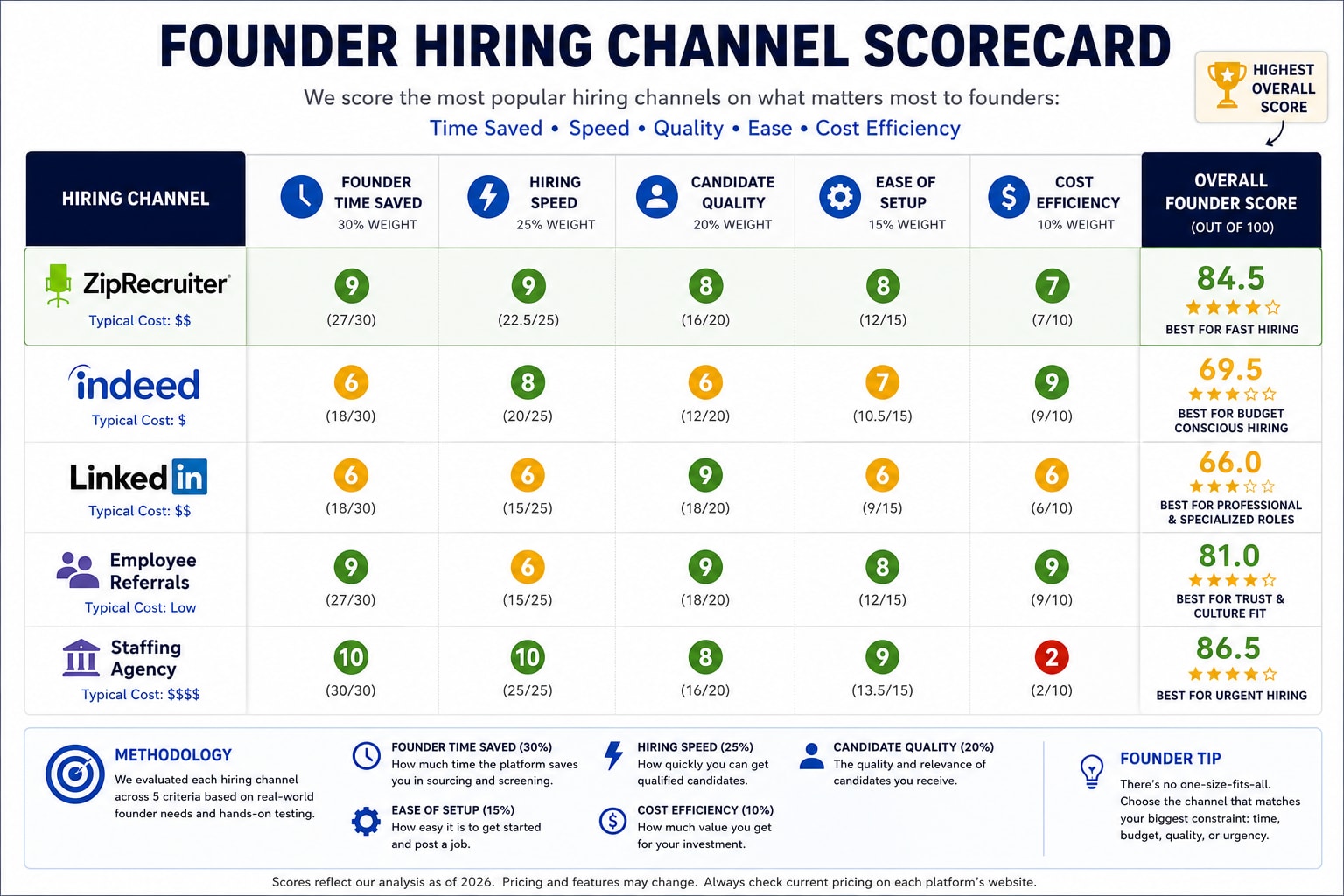
How We Evaluate Hiring Channels
Every hiring platform promises to help you find employees.
What matters is how much work it actually saves you.
At CareerCloud, we score hiring channels using five practical criteria:
- Cost
- Posting effort
- Screening effort
- Time to interview-ready candidates
- Overall founder workload
Those last two categories matter the most.
A platform that costs more but saves you 20 hours is often a better investment than a free platform that leaves you buried in resumes for two weeks.
That's why I encourage founders to think about hiring as a return-on-time investment, not simply a return-on-dollar investment.
Your time has value.
Protect it.
1. ZipRecruiter
ZipRecruiter is usually the best option when speed matters. 4 out of 5 employers get a quality candidate on day one.
If someone asked me, "I need to hire quickly, where should I start?" ZipRecruiter would usually be my first recommendation.
The biggest advantage isn't simply that your job reaches a large audience.
It's that the platform does more of the work for you.
Instead of manually posting jobs across multiple websites, ZipRecruiter sends jobs to 100+ job boards with one click. It also uses matching technology to identify candidates whose experience aligns with your job posting, helping employers get matched with relevant candidates. According to ZipRecruiter's employer resources, these matching tools are designed to surface qualified candidates earlier in the hiring process.
That doesn't guarantee you'll make the right hire.
Nothing can.
But it can dramatically reduce the amount of sourcing work required.
If you're a founder who's already juggling sales calls, payroll, customer support, and operations, those saved hours matter.
For more information, read our ZipRecruiter review.
Send your job posting to 100+ job boards with one click
2. Indeed
Indeed can make sense for employers who prioritize keeping upfront hiring costs low over saving time.
Indeed is a large job marketplace, and its free and sponsored posting options give employers flexibility when recruiting budgets are tight.
The tradeoff is founder effort.
Posting a job can get you in front of a large pool of candidates, but you'll still need to spend time reviewing applications, identifying the strongest candidates, and moving them through your hiring process.
That's where I see the biggest difference compared with ZipRecruiter.
ZipRecruiter's matching technology is designed to actively identify relevant candidates and invite them to apply. If your biggest constraint is time, I'd start there.
If your biggest constraint is budget and you're willing to do more of the screening work yourself, Indeed can still be a useful option.
For more information, read our Indeed review.
3. LinkedIn
LinkedIn is most useful when you're hiring for a professional or specialized role and are willing to spend more time sourcing candidates.
Its biggest advantage is access to professional profiles and networks, which can be useful when you're looking for someone with specific experience or industry knowledge.
But LinkedIn wouldn't be my first choice for a small business owner who simply needs to fill a role quickly with as little hands-on sourcing as possible.
You may need to spend more time searching for candidates, reviewing profiles, reaching out directly, and managing the process yourself.
For specialized roles, that extra effort may be worthwhile.
For most small businesses with limited time, I'd start with ZipRecruiter and use LinkedIn when the role requires more targeted professional sourcing.
For more information, read our LinkedIn review.
4. Employee Referrals
Referrals are usually the lowest-cost source of quality candidates.
Every founder should have a referral strategy.
Even if you also use paid job boards.
People tend to recommend coworkers they trust.
That often leads to stronger culture fit, faster onboarding, and lower recruiting costs.
The challenge is predictability.
Some hiring needs can be filled through referrals.
Others can't.
If your network is small—or you're hiring for a specialized role—you may simply not know the right person.
Think of referrals as your foundation.
Not your entire hiring strategy.
5. Staffing Agencies
Staffing agencies provide the fastest path to candidates but at the highest cost.
Sometimes speed is worth paying for.
If you're replacing a key employee, opening a new location, or filling multiple positions immediately, a staffing agency can dramatically reduce founder workload.
You're outsourcing sourcing.
You're outsourcing screening.
You're often outsourcing initial interviews.
That's why agency fees are significantly higher than posting on a job board.
For routine hiring, I don't think most small businesses need to start there.
For urgent hiring?
The math changes.
If an unfilled position is costing your business thousands of dollars every week, paying a recruiting fee may actually be the cheaper option.
The best hiring platform isn't the one with the most features.
It's the one that removes the most work from your plate.
The 5-Hour Hiring Week Framework
Most founders can run an effective hiring process in five hours per week when the workflow is standardized.
One of the biggest myths about hiring is that it has to consume your schedule.
It doesn't.
What consumes your schedule is an unstructured hiring process.
I've watched founders spend 30 minutes reviewing resumes here, answer a few candidate emails three days later, squeeze in interviews whenever they have a free hour, and then wonder why hiring feels overwhelming.
There's no system.
Everything is reactive.
That's why we developed the CareerCloud 5-Hour Hiring Week Framework.
The idea isn't to rush hiring.
It's to batch similar tasks together so you're making decisions with consistency instead of constantly switching gears.
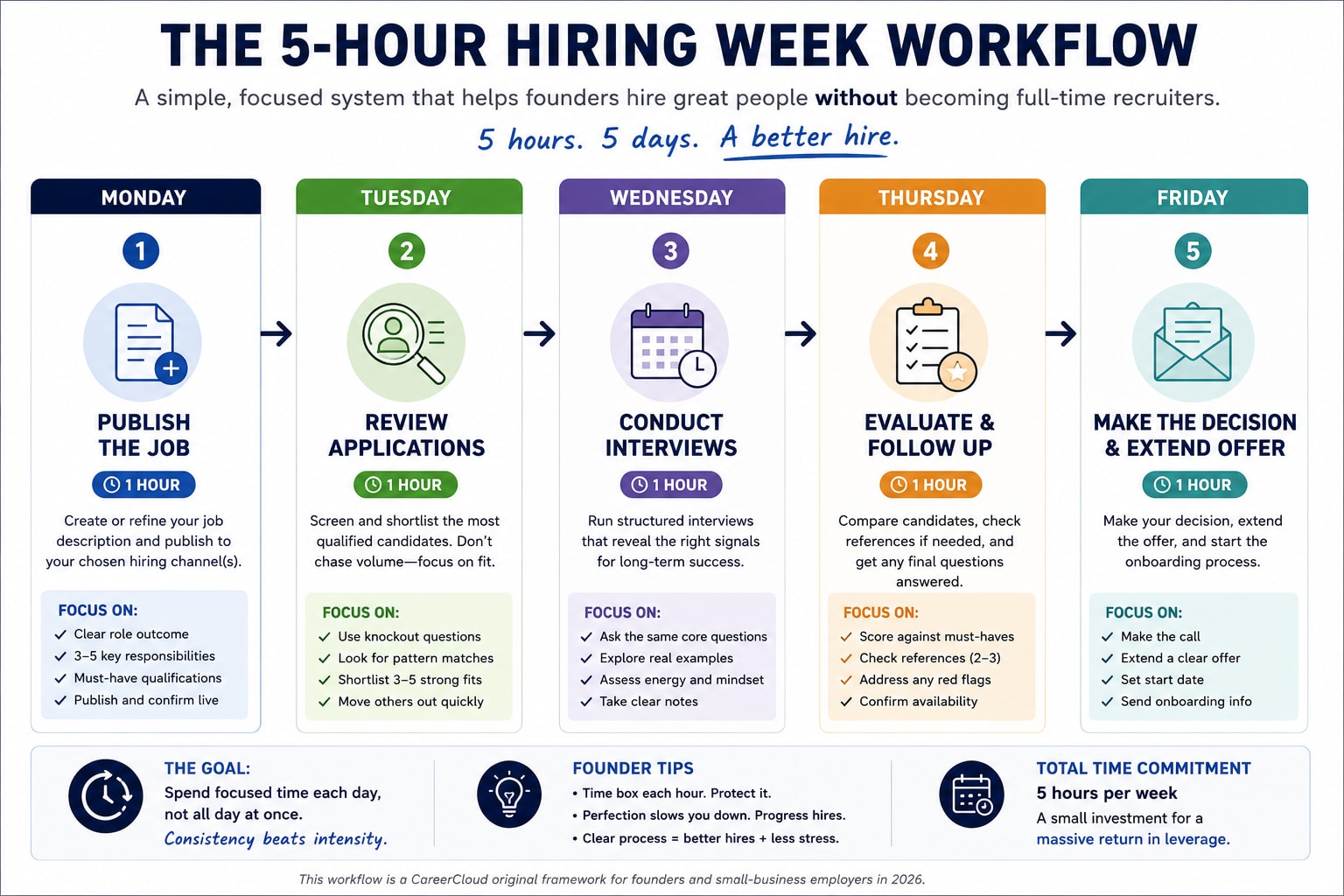
Notice what's missing.
You're not checking resumes every hour.
You're not scheduling interviews throughout the week.
You're not responding to every applicant the moment they apply.
Instead, you're giving hiring a dedicated place on your calendar.
That protects your time while also creating a better experience for candidates.
What to Prioritize
Founders should prioritize screening quality over applicant volume.
A common mistake is assuming more applicants automatically lead to better hiring decisions.
In my experience, that's rarely true.
The goal isn't to collect hundreds of resumes.
The goal is to identify a handful of qualified people worth interviewing.
That starts with a clear job description. If you need help with writing a job description, ZipRecruiter has a library of job description templates.
Candidates should understand exactly what success looks like before they click "Apply." Vague job postings attract vague applicants.
ZipRecruiter research indicates that 46.7% of job seekers would feel more seen by employers if job descriptions were more detailed, helping them narrow down which jobs are aligned with their skills and interests. Lacking clarity in job descriptions can take a toll on all parties in the job search. A lack of clarity is a primary reason for offer rejections, with 21.4% of job seekers who rejected an offer saying they did so because the job duties were unclear - a preventable outcome.
Once applications start coming in, review them consistently instead of continuously. I recommend setting aside one block of time each week to screen candidates rather than reacting every time a new application arrives.
When it's time to interview, ask every candidate the same core questions.
Structured interviews don't just make comparisons easier. Research cited by the Society for Human Resource Management (SHRM) shows that asking every candidate the same defined questions can improve consistency and help reduce bias compared with unstructured interviews.
The process doesn't have to be complicated.
It just needs to be repeatable.
What to Ignore
Most founders spend too much time perfecting job posts and too little time evaluating candidates.
I've seen employers spend two hours debating whether one sentence in a job description should say "collaborative" or "team-oriented."
Meanwhile, they spend fifteen minutes interviewing the person they may trust with thousands of dollars in customer relationships.
That's backwards.
Your job posting matters.
But it doesn't have to be perfect.
Candidates care far more about understanding the role, compensation, expectations, and company than whether every sentence sounds polished.
I'd rather see you publish a very good job description today than wait another week trying to make it perfect.
Done beats perfect.
Especially in hiring.
What to Automate
Scheduling, applicant filtering, and early candidate engagement should be automated whenever possible.
Every repetitive task you automate is time you get back.
Today's hiring tools make that easier than ever.
For example, ZipRecruiter lets employers add screening questions to job posts, helping identify candidates who meet your basic requirements before you spend time reviewing every application.
ZipIntro can take that a step further by helping employers connect with qualified candidates through scheduled video interviews. Instead of spending days coordinating initial conversations, you can move promising candidates into the interview process faster.
The same principle applies throughout your hiring process.
Use scheduling tools to eliminate the back-and-forth of finding interview times. Use templates for routine candidate communication. Automate the administrative work that doesn't require your judgment.
Those small efficiencies add up quickly.
The goal isn't to remove the human side of hiring.
It's to save your time for the part that actually needs a human.
Evaluating people.
Decision speed is founder leverage.
The faster you move qualified candidates through a structured hiring process, the less likely you are to lose them to another employer.
How Much Should You Spend to Hire an Employee?
The right hiring budget depends on how urgently you need help and how much founder time you can afford to spend.
One of the biggest mistakes I see small business owners make is treating hiring as an expense to minimize.
I think it's more helpful to think about hiring as an investment to optimize.
The question isn't, "What's the cheapest way to hire?"
It's, "What's the cheapest way to make a great hire without consuming weeks of my time?"
Those aren't always the same thing.
If you have more time than money, it makes sense to lean on referrals, networking, and free job postings.
If your business is growing quickly and every unfilled position is slowing you down, spending a few hundred dollars on a job board—or even several thousand dollars on a staffing agency—may actually save you money in the long run.
The right hiring budget depends on the value of your time.
There's no magic number.
For the ranges below, I'm talking about the recruiting budget you might set aside to fill a single open role. These aren't platform pricing tiers. Actual costs will vary based on the hiring tools you use, how long your search takes, and the level of recruiting support you need.
Under $100
Employers spending less than $100 should start with referrals and free recruiting channels.
If you're hiring on a very limited budget, I'd begin with the resources you already have.
Tell your employees you're hiring.
Reach out to your professional network.
Share the opening on LinkedIn.
Post the job on free job boards where appropriate.
This approach costs very little and often produces surprisingly strong candidates, especially if you're hiring locally or filling an entry-level role.
The tradeoff is speed.
You'll probably spend more time sourcing candidates yourself, and applicant volume may be lower than it would be through a paid platform.
If you need more reach or want to spend less time sourcing candidates yourself, ZipRecruiter is a logical next step. ZipRecruiter offers a free trial and then let's you keep your job listing live at an affordable rate with plans that can be tailored to your specific needs.
If you're not in a rush, starting with free channels is often a reasonable compromise.
$100–$600
A recruiting budget of $100-600 per open role gives small businesses more room to use paid hiring tools and expand their reach.
This is where I think most small businesses find the best balance.
Even a relatively modest recruiting budget can significantly increase your visibility while reducing the amount of manual sourcing you need to do.
As your hiring budget increases, platforms like ZipRecruiter can scale with you – offering broader reach and distribution with ad ons like Premium, Pro, and features like TrafficBoost.
The goal isn't simply to generate more applicants.
It's to generate qualified applicants faster.
That's usually where paid job boards deliver the greatest return.
$2,000+
High-urgency hiring situations may justify agency fees.
Most small businesses don't need a staffing agency.
But some absolutely do.
If you're opening a new location, replacing a key leader, hiring multiple employees in a short period of time, or filling a role that's directly tied to revenue, paying an agency can make financial sense.
Agency fees often look expensive at first glance.
So does leaving an important position vacant for another month.
If an open role is preventing your business from serving customers or generating revenue, the cost of waiting may exceed the recruiting fee.
That's why I don't recommend judging hiring costs in isolation.
Look at the total cost of an unfilled position.
Sometimes the fastest option is also the least expensive option over time.
Founder Hiring Decision Tree
The fastest way to choose a hiring strategy is to start with your constraint.
Founders often spend too much time comparing hiring platforms and not enough time identifying the problem they're actually trying to solve.
Before you post another job, ask yourself one question:
What's preventing me from making this hire?
Is it time?
Money?
A lack of qualified applicants?
Or simply not knowing where to start?
Once you're clear on the constraint, the right hiring strategy usually becomes obvious.
- Need someone in less than 14 days? → Start with ZipRecruiter or consider a staffing agency.
- Looking for someone within your network? → Start with LinkedIn.
- Working with the smallest possible budget? → Begin with employee referrals and free job postings.
- Making your first hire? → Combine referrals with one paid job board.
- Need a high volume of applicants? → ZipRecruiter will usually provide the broadest reach.
There's no single "best" hiring strategy.
There is a best strategy for your situation.
The sooner you identify your biggest constraint, the sooner you can stop wasting time on solutions that don't solve it.
If Speed Is the Priority
Employers hiring under tight deadlines should prioritize reach and screening efficiency.
When an open position is slowing down your business, speed matters more than finding the absolute perfect hiring platform.
I've seen founders spend two weeks researching recruiting software while the position they're trying to fill sits vacant.
That's backwards.
If every day without an employee is creating more work for you or costing your business revenue, choose a platform that gets qualified candidates in front of you quickly.
That's why I generally recommend ZipRecruiter for employers hiring on a deadline. Broad job distribution and candidate matching help reduce the amount of manual sourcing founders have to do.
A staffing agency can make sense when the timeline is even shorter.
Yes, it costs more.
But so does leaving an important position unfilled for another month.
Move quickly.
Just don't confuse moving quickly with lowering your hiring standards.
If Budget Is the Priority
Employers with limited budgets should prioritize referrals and free distribution channels.
Every small business starts somewhere.
If your recruiting budget is limited, don't assume you need expensive software to make a great hire.
Start with the people who already know your business.
Ask employees for referrals.
Reach out to trusted professional contacts.
Share the opening on LinkedIn.
Post on free job boards where appropriate.
If that doesn't generate enough qualified candidates, then consider investing in a paid job board.
Too many employers reverse that order.
Referrals don't cost much.
They often produce some of the strongest candidates you'll interview.
If This Is Your First Hire
First-time hiring managers should focus on simplicity rather than building a complex process.
I've noticed first-time employers often assume they need an elaborate hiring system.
You don't.
You need a repeatable one.
Start with a clear job description.
Decide what success looks like during the first 90 days.
Ask every candidate the same core interview questions.
Evaluate everyone using the same criteria.
Then make a decision.
You don't need applicant tracking software, multiple interview panels, or six rounds of interviews.
You need clarity.
Your first hiring process should be simple enough that you'll actually follow it.
You can always add complexity later.
Most founders do the opposite.
They build a Fortune 500 hiring process for a five-person company.
That's unnecessary.
Simple processes get completed. Complicated processes get postponed.
For more tips, check out our guide on how to hire dependable employees for your small business.
Is ZipRecruiter Worth It for Small Businesses?
ZipRecruiter is worth the cost when hiring speed matters more than minimizing spend.
I don't think there's a single hiring platform that's right for every employer.
If you've read other reviews on CareerCloud, you know that's how we approach every recommendation. The best tool depends on your hiring goals, budget, timeline, and the amount of work you're willing to do yourself.
That said, ZipRecruiter consistently stands out for one reason.
It helps founders save time.
That's valuable when you're already running sales, operations, customer service, and everything else that comes with owning a business.
Instead of manually posting jobs across multiple websites, ZipRecruiter distributes your listing broadly and uses matching technology to find relevant candidates.
The technology scans resumes for factors like skills, education, and experience that align with your job. When it identifies a potential match, ZipRecruiter can proactively invite that candidate to apply.
That's an important distinction.
You're not just posting a job and waiting for the right person to find it. The platform is actively helping bring relevant candidates to you.
That doesn't mean every applicant will be a perfect fit.
It means you can spend less time sourcing candidates yourself and more time evaluating the people worth interviewing.
For many founders, that speed can make a meaningful difference. According to ZipRecruiter, 4 out of 5 employers who post a job on the platform get a quality candidate within the first day.
If time is your biggest constraint, that's a compelling return on investment.
If budget is your biggest constraint, another option may make more sense.
I recommend it to founders who value buying back their time.
When ZipRecruiter Makes Sense
ZipRecruiter works best when founders value time savings over platform costs.
I'd seriously consider ZipRecruiter if any of these sound familiar:
- You're trying to hire within the next few weeks.
- You're balancing hiring with running the rest of your business.
- You don't have an internal recruiter or HR team.
- You're willing to spend more to reduce the amount of manual sourcing and screening.
- An unfilled position is slowing down your business.
In those situations, the cost of the platform is often small compared to the cost of waiting.
I've seen founders spend weeks trying to avoid paying for a hiring platform while losing far more in missed opportunities because they simply couldn't move the hiring process forward.
Sometimes the cheapest option becomes the most expensive one.
When Referrals Beat Both
Referrals can outperform paid platforms when strong professional networks already exist.
Some of the best hires never come from a job board.
They come from someone who already knows your business.
Employee referrals often produce candidates who understand your company culture before they ever interview. Existing employees also have an incentive to recommend people they believe will succeed, especially if referral bonuses are involved.
The challenge is consistency.
Not every business has a large network.
Not every role can be filled through referrals.
That's why I usually think of referrals as the first hiring channel to try—not the only one.
When referrals produce a great candidate, you've likely saved both time and money.
When they don't, you can always expand your search with a job board.
The smartest hiring strategy isn't choosing one platform forever.
It's knowing when to use each one.
Use the hiring channel that removes the biggest bottleneck in your business—not simply the one with the lowest price tag.
Common Hiring Mistakes Small Businesses Make
Most hiring mistakes stem from poor process design rather than poor candidate availability.
When a hiring process doesn't produce good candidates, it's tempting to blame the job market.
Sometimes that's true.
Most of the time, it isn't.
I've found that small business hiring problems usually come back to the same handful of mistakes. The good news is they're all fixable.
Related: How To Find Employees In A Competitive Job Market
Waiting Too Long to Hire
The biggest mistake founders make is assuming they'll hire after things slow down.
They won't.
Business rarely gets less busy on its own.
The longer you wait, the more responsibilities pile onto your plate, and the harder it becomes to make time for hiring.
At some point, delaying a hire becomes more expensive than making one.
Writing Vague Job Descriptions
Candidates can't hit a target they can't see.
One of the fastest ways to attract the wrong applicants is to write a job description that's full of buzzwords but light on specifics.
Tell candidates exactly what they'll be responsible for.
Explain what success looks like.
Be transparent about expectations.
Clarity attracts better applicants.
Chasing Volume Instead of Fit
More applications don't automatically produce better hiring decisions.
In fact, they often create more work.
I'd rather review 20 qualified applicants than 200 unqualified ones.
That's why your hiring channel matters so much.
The goal isn't maximizing applications.
It's maximizing qualified interviews.
Moving Too Slowly
Great candidates often disappear because employers move too slowly.
Strong candidates usually aren't on the market for long.
If your interview process stretches across multiple weeks without communication, don't be surprised if your top choice accepts another offer.
Decision speed is a competitive advantage.
Candidates are evaluating your company just as much as you're evaluating them.
Hiring Only for Skills
Skills get candidates hired, but behaviors determine long-term success.
One of the biggest lessons I've learned is that technical skills are only part of the equation.
You can teach someone a new software platform.
You can't easily teach curiosity.
Or accountability.
Or ownership.
Those qualities often determine whether someone becomes a long-term contributor.
A resume tells you what someone says they can do. A structured interview tells you how they think.
That's why I encourage founders to ask every candidate the same thoughtful questions and evaluate responses consistently.
Skills matter.
Character matters more.
Frequently Asked Questions
How can a small business hire employees with limited time and resources?
The fastest approach is to use a hiring channel that reduces sourcing and screening work, create a clear job description, and focus only on qualified applicants instead of maximizing application volume.
What is the best hiring platform for small businesses with limited time?
ZipRecruiter is often the best fit for employers who prioritize speed because it distributes jobs broadly and includes candidate matching tools.
How many hours per week should a founder spend hiring?
Most small-business hiring processes can be managed in three to five hours per week when sourcing, screening, and interview steps are standardized.
Is ZipRecruiter worth it for small businesses?
Yes! Unlike other platforms where you pay per view, ZipRecruiter gives you unlimited clicks
and applications on your job post. Attract the maximum number of candidates for the same simple price.
What is the cheapest way to hire employees?
Employee referrals, local networking, and free job postings are usually the lowest-cost hiring channels, although they may require more time and generate fewer candidates.
Final Thoughts
Hiring is one of the few investments that can immediately change the trajectory of your business.
The mistake I see founders make isn't choosing the wrong job board.
It's believing they need to do everything themselves until they have "more time."
That day rarely comes.
The right hire gives you something far more valuable than another set of hands.
It gives you back your attention.
When you're evaluating hiring channels, don't focus only on the posting price. Think about the total cost of making the hire. How much founder time will you spend writing the job description, sourcing candidates, reviewing resumes, scheduling interviews, and following up?
Sometimes the cheapest option is exactly the right choice.
Sometimes spending a few hundred dollars saves you weeks of work.
That's why I encourage founders to start with their biggest constraint.
If you're working with a very limited budget, begin with referrals, networking, and free job postings.
If you're hiring for a specialized professional role, LinkedIn is often worth the investment.
If speed is your biggest priority and you want to reduce the amount of manual work involved, ZipRecruiter is one of the strongest options available.
No hiring platform can guarantee you'll make the perfect hire.
But the right hiring process can dramatically improve your odds.
Hiring isn't about adding headcount.
It's about creating leverage so your business can grow without depending on you for everything.
If you need qualified candidates quickly and have a budget for hiring, evaluate ZipRecruiter alongside employee referrals, then choose the option that reduces the most founder workload—not simply the lowest-cost option.

