




Most employers think they have a candidate problem.
The truth is they have a decision-speed problem.
Hiring fast is rarely about posting in more places. It's about removing friction between application and offer.
I've talked to hundreds of small business owners over the years. Most assume hiring takes weeks because finding good people is difficult.
Sometimes that's true.
More often, the delay happens after someone applies.
Applications sit in an inbox for three days. Interviews get pushed to next week because everyone's calendar is full. The hiring manager wants one more opinion before making an offer.
Meanwhile, candidates are expecting employers to move quickly. ZipRecruiter research found that nearly half (49%) of job seekers expect to hear from an employer within three days of applying, and more than two-thirds (67.9%) want a fast response from employers, even if it’s a no.
That's the hidden cost of slow hiring.
The employers that consistently hire great people aren't always the ones with the biggest budgets. They're the ones who know exactly what they're looking for and move when they find it.
Decision speed is founder leverage.
This guide will show you the hiring methods that consistently move the fastest, the bottlenecks that quietly add days or weeks to your process, and the exact framework we use to think about hiring speed at CareerCloud.
What Is the Fastest Way to Hire an Employee?
Employee referrals, job sites like ZipRecruiter, and staffing agencies are typically the fastest hiring channels because they can produce qualified candidates the same day and lead to hires within one to seven days.
Quick Verdict
Best for: Employers who need someone working immediately
Time to hire: Often 1–7 days
Skip if: You're hiring highly specialized professional or executive talent
Alternative: ZipRecruiter for broader candidate reach without using an agency; 4 out of 5 employers who use ZipRecruiter get a quality candidate within one day.
If you aren't hiring under immediate pressure, a self-service hiring platform paired with a disciplined hiring process can still dramatically reduce your time to hire. The goal isn't simply to attract applicants.
It's to remove every unnecessary delay between application and accepted offer.
How Fast Can You Realistically Hire an Employee?
Most small-business hires take one to four weeks, but many employers can reduce time-to-hire to 48 hours by removing unnecessary delays.
That surprises a lot of founders.
They assume hiring is slow because recruiting is slow.
It usually isn't.
Tools can also help employers quickly identify candidates worth moving forward. ZipIntro, for example, lets employers connect with potential candidates through brief introductory calls. Jobs that use ZipIntro receive over 16x more quality applications than other jobs. (Disclaimer: ZipRecruiter Internal Data, 2025)
Because it means you control most of the timeline.
According to the Society for Human Resource Management (SHRM), extended vacancies increase the burden on existing employees, can drive overtime and training costs, and create operational disruptions that make hiring even more expensive over time. Every extra day a position stays open has a cost—even if it doesn't show up on a balance sheet.
The mistake I see most often isn't writing a weak job description.
It's waiting.
Waiting to review applications.
Waiting to schedule interviews.
Waiting for everyone to agree.
Waiting for the "perfect" candidate.
I've made that mistake myself.
Early in my career, I believed more interviews meant better hiring decisions. If I talked to one more candidate or asked one more person for feedback, surely I'd make a smarter choice.
Instead, I lost strong candidates who were ready to say yes.
That experience completely changed how I think about hiring.
Fast hiring isn't rushed hiring.
It's prepared hiring.
When you know exactly what success looks like before you post the job, decisions become much easier once candidates start applying.
Decision speed is founder leverage.
Why Most Hiring Processes Move Too Slowly
Most employers hire slowly because decisions move slowly, not because candidates are unavailable.
Hiring delays compound.
Wait three days to review applications, and your strongest candidates may already be interviewing elsewhere. In fact, according to ZipRecruiter research, nearly half (49%) of job seekers expect to hear from an employer within 3 days of applying.
Nearly half (49%) of job seekers expect to hear from an employer within 3 days of applying, according to ZipRecruiter.
Schedule interviews a week out, and you'll lose candidates who were excited on Monday but accepted another offer by Friday.
Add four interview rounds for an entry-level position, and candidate drop-off becomes almost inevitable.
None of those delays improve hiring quality.
They simply slow the process down.
The four biggest bottlenecks I see are:
- Reviewing applications only once or twice a week.
- Scheduling interviews around internal calendars instead of candidate availability.
- Adding interview rounds that don't change the final decision.
- Waiting days to extend an offer after everyone already agrees.
Here's the reframe.
Most founders don't lose candidates because someone else pays more.
They lose candidates because someone else decides faster.
If this is your first time building a hiring process, don't overcomplicate it.
A simple process that everyone follows will outperform a complicated process that nobody sticks to. Our guide on How to Hire Your First Employee walks through the fundamentals if you're hiring for the first time.
Why Referrals Are Usually the Fastest Hiring Method
Employee referrals often produce qualified candidates faster than any paid hiring channel.
A referral starts with trust.
Someone on your team has already done part of the evaluation before you ever schedule an interview.
That doesn't guarantee a great hire.
But it dramatically reduces uncertainty.
I've found that referrals also create better conversations. Instead of spending half the interview figuring out whether someone is legitimate, you can spend that time determining whether they're the right fit for the role.
For most small businesses, referrals should be the first hiring channel you activate.
They're inexpensive.
They're fast.
And they often produce your highest-quality hires.
When Staffing Agencies Beat Every Other Option
Staffing agencies are usually the fastest solution when you need immediate coverage.
Sometimes speed outweighs cost.
If you're trying to cover manufacturing shifts, warehouse positions, seasonal work, or temporary administrative support, a staffing agency already has candidates ready to work.
You're paying for access to that existing pipeline.
That's why agencies routinely produce hires within days instead of weeks.
They're not the best solution for every role.
If you're hiring a long-term executive or highly specialized professional, you'll usually want more control over the recruiting process.
But if every vacant shift costs your business money, staffing agencies are difficult to beat.
Why ZipRecruiter Works Well for Most Small Businesses
ZipRecruiter can be especially useful for small businesses that need to find qualified candidates quickly without adding more work to an already full plate.
Most small business owners don't have time to manually post jobs across multiple hiring websites. They're running the business. Hiring is just one more responsibility.
That's where ZipRecruiter can help. Employers can post a job once and send it to 100+ job boards with one click, while ZipRecruiter's matching technology helps identify qualified candidates and invites them to apply.
And for employers looking to hire quickly, 4 out of 5 employers who post a job on ZipRecruiter get a quality candidate within the first day.
That combination of reach, matching technology, and ease of use can be especially valuable for small businesses without dedicated recruiting teams.
For more information, check out our ZipRecruiter review.
The 48-Hour Hiring Playbook
A small business can often hire within 48 hours if every step is planned before the job is posted.
This is the biggest mindset shift I want founders to make.
Most hiring processes are reactive.
The best hiring processes are prepared.
The employers who hire quickly don't scramble after applications start coming in. They've already decided who owns the hiring decision, when interviews will happen, what questions they'll ask, and how they'll evaluate candidates.
That's why they move faster.
The playbook below isn't theoretical. It's simply a way to remove every unnecessary pause from your hiring process.
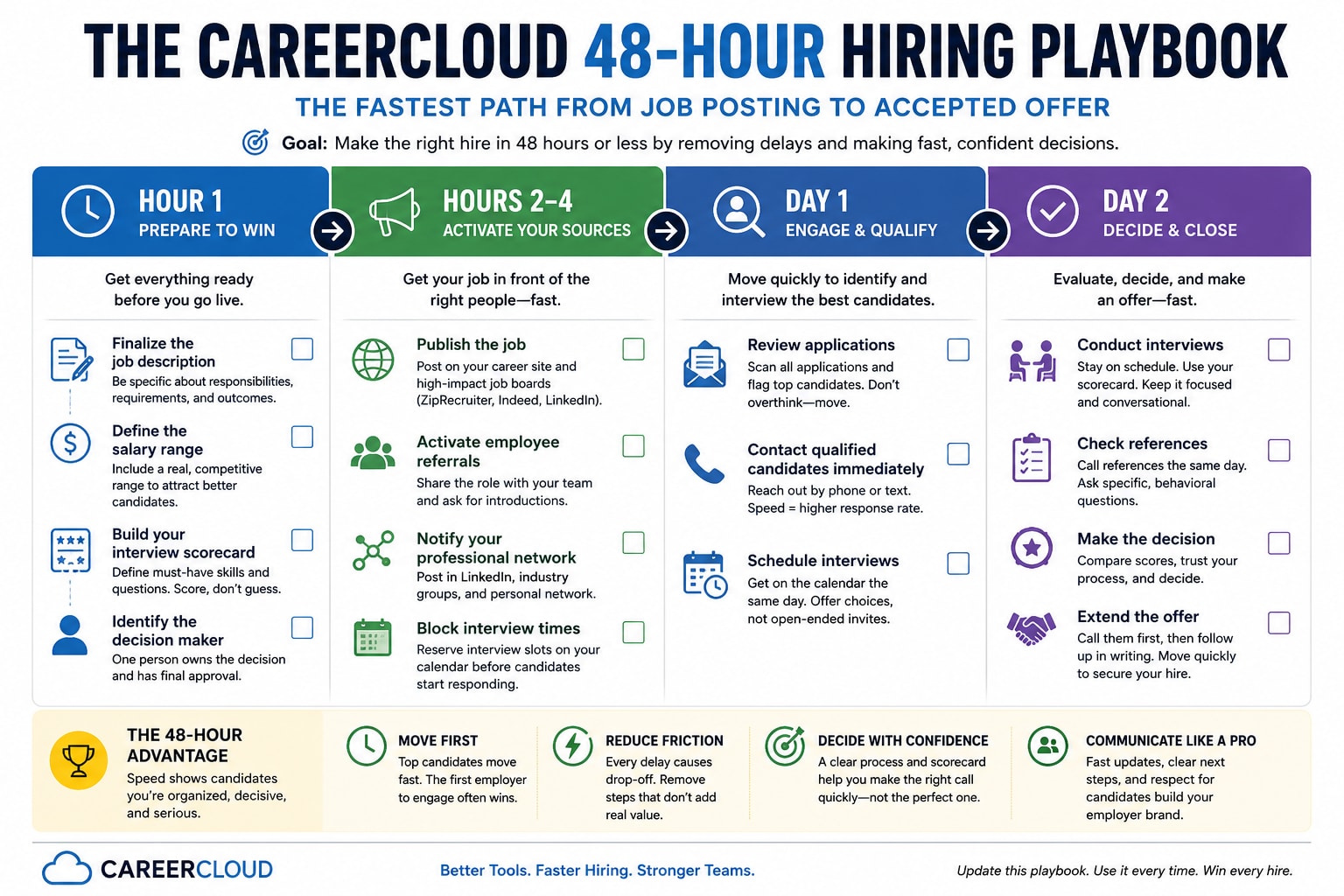
Hour 1: Prepare to Win
Before your job goes live, make four decisions.
Finalize the job description.
Don't create a wish list.
Create a success profile.
Be specific about responsibilities, expectations, and what success looks like after 90 days. Vague job descriptions attract vague applicants.
For extra help, head over to ZipRecruiter to browse job description templates.
Define the salary range.
Employers that include salary information often receive more qualified applicants because candidates can immediately determine whether the opportunity fits their expectations. It also eliminates conversations that were never going to end in an accepted offer.
According to ZipRecruiter research, 27.1% of job seekers would feel more seen if employers provided salary transparency upfront.
Don't waste your time.
Or theirs.
Build your interview scorecard.
One of the easiest ways to speed up hiring is deciding how you'll evaluate candidates before you meet them.
I recommend identifying five or six must-have qualities for the role.
Every interviewer should score against the same criteria.
That prevents interviews from becoming conversations that end with, "I liked them, but I'm not sure why."
Score.
Don't guess.
Define the decision maker.
This sounds obvious.
It isn't.
I've seen hiring decisions stall because nobody knew who actually had the authority to make the offer.
Decide that before you post the job.
Not after you've found the right candidate.
Hours 2–4: Activate Your Sources
Once you're prepared, it's time to create visibility.
Publish the job.
Start with your careers page, then distribute it through the hiring platforms that make sense for your role.
For many small businesses, that means a combination of ZipRecruiter, Indeed, LinkedIn, and your own website.
Don't rely on a single source.
Activate employee referrals.
This should happen the same day.
Send a message to your team explaining exactly who you're looking for, what the position involves, and who would be a great fit.
The more specific you are, the better your referrals become.
Clarity breeds better referrals.
Notify your professional network.
One LinkedIn post can introduce your opportunity to hundreds or even thousands of professionals who already know your business.
Don't overthink it.
Tell people you're hiring.
Ask them to share it.
Block interview time on your calendar.
This is one of the simplest ways to eliminate delays.
Reserve interview slots before candidates apply.
That way, when someone impresses you, your response becomes:
"Can you meet tomorrow at 10?"
Instead of:
"I'll check everyone's calendar and get back to you."
Those two responses can be the difference between making the hire and losing it.
Day 1: Engage and Qualify
Fast hiring requires fast communication.
Review applications as they arrive.
Don't wait until Friday.
If someone looks promising, contact them the same day.
Phone calls and text messages typically receive faster responses than email alone, especially for hourly positions.
Then schedule interviews immediately.
This is also where ZipIntro can help you compress the hiring timeline. ZipIntro matches your job with candidates, invites them to a scheduled session, and lets you conduct back-to-back video screening calls directly through ZipRecruiter.
According to ZipRecruiter, nearly 4 out of 5 employers receive their first RSVP within 20 minutes of scheduling a ZipIntro session. (Disclaimer: ZipRecruiter Internal Data, 2025)
For a 48-hour hiring sprint, that's exactly what you want: less scheduling back-and-forth and more time actually talking to candidates.
Notice the pattern?
Every step removes waiting.
That's intentional.
Day 2: Decide and Close
Interview.
Check references.
Make the decision.
Extend the offer.
The strongest candidates don't stay available indefinitely.
I've watched founders spend another three or four days debating candidates they already knew they wanted.
Nothing changed during those four days.
Except the candidate accepted another offer.
If your interview scorecard clearly identifies one candidate as the strongest fit, trust the process you built.
Then move.
What Must Be Ready Before You Post the Job
The fastest hiring processes start before the job goes live.
Many employers believe hiring starts when they publish a job posting.
I don't.
Hiring starts when you've answered four questions:
- What outcomes will define success in this role?
- What skills are truly non-negotiable?
- Who makes the final hiring decision?
- How quickly are we prepared to move?
Once those questions are answered, recruiting becomes much simpler.
Because you're no longer figuring things out as you go.
You're executing a plan.
This is another reframe.
Fast hiring isn't about moving faster.
It's about making fewer decisions after candidates apply.
Why Same-Day Candidate Follow-Up Matters
Candidate response rates fall when employers wait days to make contact.
Think about your own buying behavior.
When you're excited about something, you want a response now.
Candidates aren't any different.
Someone who applied Monday morning may still be enthusiastic Monday afternoon.
By Thursday, they've interviewed elsewhere.
Momentum matters.
That's why I encourage founders to review applications every day instead of once or twice a week.
You don't need to interview every applicant immediately.
You just need to acknowledge the good ones before another employer does.
Small improvements compound.
Responding the same day.
Scheduling interviews within 24 hours.
Sending an offer immediately after making a decision.
Individually, those don't seem dramatic.
Together, they can reduce your hiring timeline from several weeks to just a few days.
What's Slowing Down Your Hiring Process?
Most hiring delays come from process bottlenecks rather than candidate shortages.
When founders tell me they're struggling to hire, my first question usually isn't, "Where are you posting jobs?"
It's this:
"Walk me through what happens after someone applies."
That's where the bottlenecks usually appear.
Applications wait two days before anyone opens them.
Interview scheduling takes another week.
The hiring manager is on vacation.
The owner wants to interview every finalist.
Nobody has permission to make an offer.
None of those problems have anything to do with recruiting.
They're process problems.
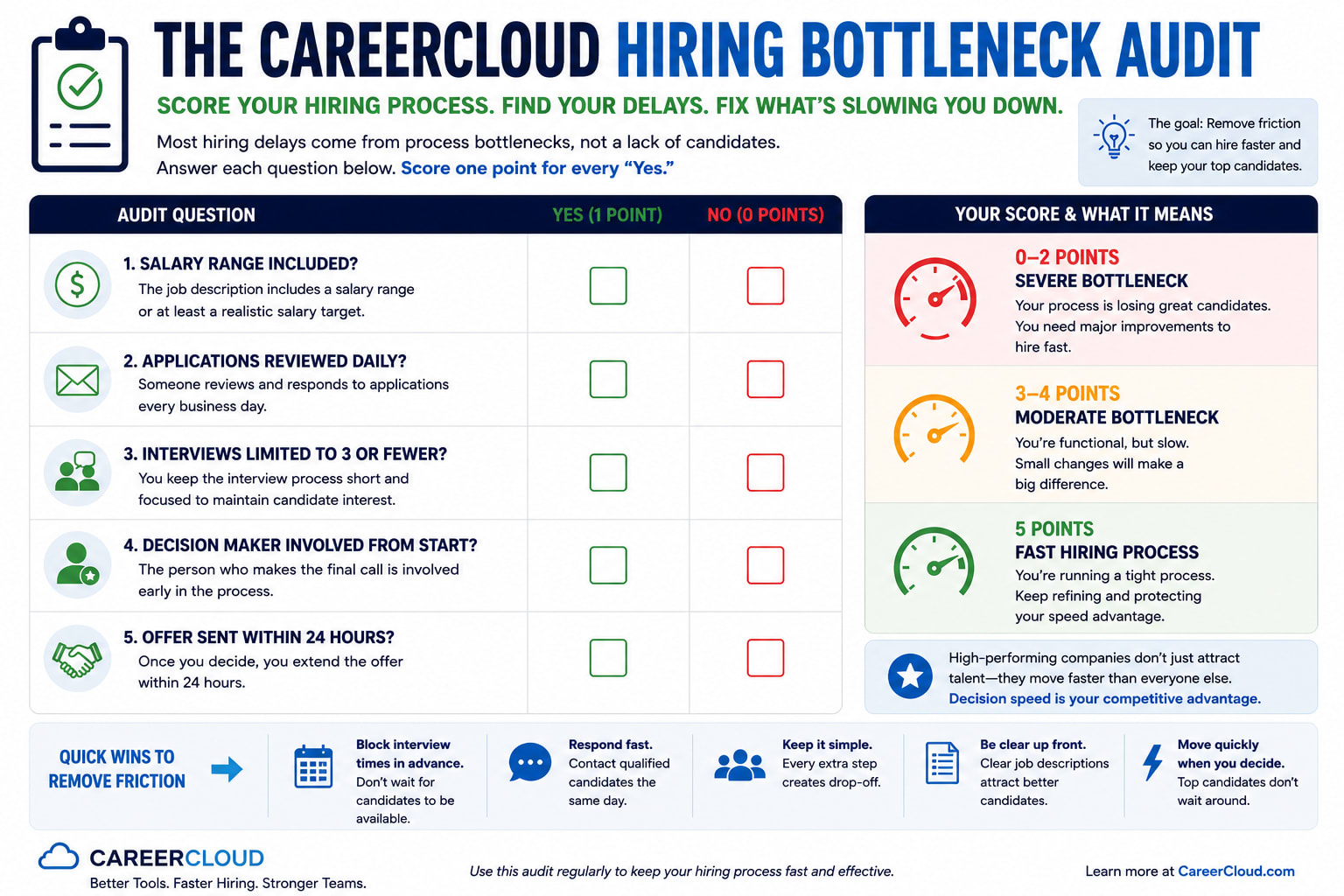
Score yourself.
Give yourself one point for each statement that's true.
- □ The job description includes a salary range.
- □ Applications are reviewed every business day.
- □ Candidates go through three interviews or fewer.
- □ The decision maker is involved from the beginning.
- □ Offers are extended within 24 hours of making a decision.
Your Score
0–2 points: Severe Bottleneck
Your hiring process is probably costing you strong candidates. Before spending more money on recruiting, fix the delays inside your existing process.
3–4 points: Moderate Bottleneck
You're doing many things well, but a few unnecessary delays are keeping you from hiring as quickly as you could.
5 points: Fast Hiring Process
You've built a process that prioritizes responsiveness and clear decision-making. Protect it. Speed is now one of your competitive advantages.
The Four Most Common Hiring Delays
Slow reviews, excessive interviews, unclear requirements, and delayed decisions cause most hiring slowdowns.
If I could only fix four things inside a hiring process, these would be my priorities.
- Applications aren't reviewed every day.
Candidates shouldn't wait several days just to learn whether you're interested.
- The interview process is too long.
More interviews rarely produce better hiring decisions.
They usually produce more candidate drop-off.
- The role isn't clearly defined.
If your interview team disagrees about what success looks like, every hiring decision becomes harder than it needs to be.
Clarity creates speed.
- Nobody owns the final decision.
I've watched companies lose excellent candidates because everyone thought someone else would make the offer.
Ownership matters.
If you're building your hiring process for the first time, keep it simple.
A process that everyone follows consistently will outperform an elaborate process that nobody can explain.
Which Hiring Method Is Fastest for Your Role?
The fastest hiring channel depends heavily on the role you're trying to fill.
There isn't one hiring platform that's best for every position.
A restaurant hiring servers has different needs than a software company hiring engineers.
The right question isn't:
"What's the fastest hiring platform?"
It's:
"What's the fastest hiring platform for this role?"
Every hiring channel has strengths.
The goal isn't finding the "best" platform.
It's matching the platform to the hiring challenge.
Hiring Hourly Workers Fast
Hourly hiring typically moves fastest through ZipRecruiter, referrals, and local recruiting channels.
Hourly recruiting is usually a volume game.
You need enough qualified applicants entering your pipeline quickly.
That's where ZipRecruiter performs particularly well.
Pair it with employee referrals and local Facebook or community groups, and you can often build candidate flow within the first day.
The bigger opportunity, though, is responsiveness.
Hourly candidates often accept the first reasonable offer they receive.
Move first.
Hiring Skilled Trades Fast
Trade hiring moves fastest through referrals, associations, and specialized local networks.
General job boards still have value.
But skilled trades are relationship-driven.
Ask your current employees for referrals.
Connect with trade associations.
Partner with local apprenticeship programs.
Those channels consistently outperform broad recruiting when hiring experienced technicians.
Hiring Professional Employees Fast
Professional hiring often requires a balance between speed and candidate quality.
Professional hiring shouldn't become slow hiring.
It simply requires more intentional evaluation.
ZipRecruiter is a great place to hire for knowledge-based roles.
Don't confuse additional interviews with additional certainty.
The best hiring decisions usually come from better preparation—not longer processes.
Why We Recommend ZipRecruiter for Fast Hiring
If your goal is to hire quickly without building a complicated recruiting process, ZipRecruiter is our top recommendation.
Most small businesses don't need more recruiting tools.
They need a hiring platform that helps them reach qualified candidates quickly while keeping the process simple.
That's where ZipRecruiter stands out.
Instead of posting jobs one at a time across multiple job posting sites, you can create a single job listing and manage applicants from one dashboard. That saves time from the moment your job goes live through the interview process.
At CareerCloud, we don't evaluate hiring platforms based on feature lists alone. We look at how quickly they generate qualified applicants, how easy they are to use, whether they reduce manual work for employers, and whether they provide good overall value for small businesses.
For most employers, ZipRecruiter consistently performs well across all of those areas.
Why We Recommend ZipRecruiter
If I had to recommend one self-service hiring platform for most small businesses, ZipRecruiter would be my first choice.
It solves several hiring challenges at the same time.
You can publish one job, reach a broad audience of active job seekers, review applicants from a centralized dashboard, and move candidates through the hiring process without juggling multiple systems.
For owners and managers already balancing dozens of responsibilities, that simplicity matters.
Strengths
- Excellent balance of speed and candidate volume. In fact, 4 out of 5 employers get a quality candidate on day one.
- Streamlines the hiring process through a single dashboard.
- Easy to use, even without a dedicated recruiter or HR team.
- Well-suited for businesses making occasional hires.
- Saves time by reducing manual recruiting tasks.
Limitations
- Results still depend on writing a clear job description and responding to applicants promptly.
Best For
Small businesses that want an easy-to-manage hiring platform capable of filling positions quickly without adding unnecessary complexity to the recruiting process.
Our Bottom Line
Most hiring delays aren't caused by a lack of applicants.
They're caused by slow processes, scattered recruiting efforts, and too much manual work.
ZipRecruiter helps solve those problems by making it easier to get your job in front of qualified candidates and manage the hiring process from one place.
If you're a small business looking for the simplest way to hire faster, it's the platform we recommend first.
Founder Edition
The fastest path is usually the one that removes the most decision friction.
Most founders spend too much time trying to optimize the recruiting channel.
The bigger opportunity is optimizing the process.
Know what you're looking for.
Know who makes the decision.
Know when interviews will happen.
Know when you'll extend an offer.
Everything else becomes easier after that.
Here's the final reframe.
Hiring fast isn't about rushing.
It's about creating a process where the right decision becomes obvious sooner.
When you remove friction, you don't just hire faster.
You become a better employer.
And in today's hiring market, that's one of the biggest competitive advantages you can build.
Frequently Asked Questions
What is the fastest way to hire an employee?
Employee referrals and staffing agencies are usually the fastest hiring methods because they can generate candidates immediately and often lead to hires within one week.
How can a small business hire employees fast?
Small businesses hire faster by posting salary ranges, reviewing applications daily, limiting interviews, and making same-day hiring decisions whenever possible.
How long does it take to hire an employee?
Most small-business hires take one to four weeks, but highly streamlined hiring processes can reduce that timeline to as little as 48 hours.
Is ZipRecruiter good for hiring fast?
ZipRecruiter is one of the fastest self-service hiring platforms because it sends jobs to 100+ job boards with one click and helps employers reach active job seekers quickly.
What's slowing down my hiring process?
The most common causes of slow hiring are delayed application reviews, too many interview rounds, unclear job requirements, and slow decision-making.
Hiring Fast Is About Removing Friction
Most founders think hiring faster means lowering their standards.
I think the opposite is true.
The best hiring processes are usually the clearest hiring processes.
Everyone knows what success looks like.
Everyone understands who makes the final decision.
Everyone moves quickly when the right candidate appears.
That's why I encourage founders to focus less on finding the perfect hiring platform and more on building a process that eliminates unnecessary delays.
Because here's the reality.
You can post on every major job board available.
You can buy premium recruiting tools.
You can spend thousands of dollars attracting applicants.
None of it matters if qualified candidates spend three days waiting for someone to review their application.
That's the real bottleneck.
Hiring fast is not about cutting corners.
It's about removing friction so the right person can say yes before someone else does.
If you need qualified candidates quickly and don't want to manually distribute jobs across multiple hiring channels, tools like ZipRecruiter can dramatically reduce the time between posting a role and receiving applications. Compare your options, understand the tradeoffs, and choose the hiring channel that matches both your timeline and the type of employee you're trying to hire.


